

When Seattleites think African food, the first thing that comes to mind is probably one of our region’s umpteen Ethiopian restaurants. And don’t get me wrong, I enjoy the tangy, expand-in-your-stomach pleasures of injera as much as the next guy.
But the craving that followed me home from a four month visit to East Africa, and has haunted my pallet in the 5 years since, is not Ethiopian at all – it’s Kenyan.
I was at a loss to satisfy this craving until this last weekend, when I finally set out, determined to make it happen. My short quest took me to an eclectic strip mall on 108th Ave SE in Kent, where Uhuru Kenyan Cusine sits nestled between tanning salons, tax preparers and a couple of halal restaurants.
Nduta Muune, who hails from the Ngong Hills outside of Nairobi, is Uhuru’s mastermind, owner, head chef and sometimes waitress. She came to the Northwest 18 years ago, and spent most of that time working as a secretary at Swedish Medical Center.
“When I came here, there was just a small community. I used to cook and have house parties,” she told me. “Then the community grew, and there was no restaurant.”
She opened Uhuru in October 2010 to fill that need (though to be fair, there was another Kenyan restaurant called Safari Njema lurking right under my nose in Columbia City all this time).
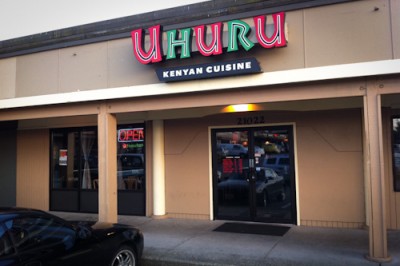
Muune definitely delivers on her promise of authentic Kenyan food and atmosphere. I walked in early Saturday to a dim, sparsely furnished room with a dozen numbered tables and a full bar. A couple of guys were swaying confidently to Congolese pop music on the raised dance floor, while simultaneously rooting for the turncoat Oklahoma City Thunder playing on the flatscreen.
After 9 or 10pm on weekends, Muune promises the place turns into a full on dance club, where throngs of the Northwest’s small Kenyan community come to groove to African music – and wazungu are welcome as well.
I’ll have to take her word for it. But I can attest to the authenticity of the food.
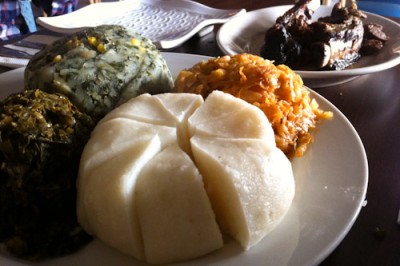
Kenyan food is subtle and nutritious, but it’s not very elaborate, which is probably why there aren’t a lot of Kenyan restaurants around. It bears an interesting resemblance to Southern food, from nyama choma (barbecued beef ribs) to ugali the staple white cornmeal cake, to my personal favorite, sukuma wiki, sauteed collard greens.
Muune’s versions of all of these were true to my Kenyan memories, as were the ground beef filled Samosas and the Ng’ombe Mchuzi (Beef Stew).
If a visit to Uhuru is your first experience with Kenyan food, ask for a sampling of her recommended dishes. You’ll get what’s freshest, and you’ll come away with a pretty good idea of what Kenyan food is like (if you’re lucky, there might even be some goat involved).
The best part is, you’ll probably leave feeling pretty good. That’s what I love most about Kenyan food: it’s so oriented toward nutrition. Take sukuma wiki, the Swahili name is itself a boasts that eating it will “sustain you for a week.”
Throw in some free range beef, and a ball of ugali, and I’m ready to sprint up the side of Mount Kenya.

UGALI! Finally a place to get ugali. Thanks for the article. BTW I found a place to get dosa in the U. District-. Chili’s on 55th Street and the Ave.
Yeah, we’ve been going to Chili’s quite a bit b/c it’s so close to UW. Delicious, and all you can watch Bollywood music videos!
Have you tried Somali food? Two of my fav restaurants are Benadir in S. Seattle and Marwa in Tukwila — YUM! Hungry just thinking bout some Kata Kata right now!!
I’ve never had Somali food (unless you count that time I chewed a bunch of Qat). I can’t wait to check those places out though.
Will have to try some Kenyan food here in NYC. Good post!
Uhuru’s a great joint to hang out and eat great fresh food. Good for you discovering Uhuru. Great music too.
Please get in touch with me, I have a serious issue and needs to contact a kenyan at Seattle
Thanks in advance
Regards
Esther
Esther, you can email me at sarah@seattleglobalist.com
* UPDATE
UHURU restaurant was closed permanently, But Safari Restaurant in Columbia City is is open for business,Small, clean place with friendly people.
Yours lovely,
Kenyan Neighbor in Seattle- Anthony